Michael Scheuer, one of Ron Paul's key foreign policy advisors, has predicted in an interview televised on Fox News that the fighting in Afghanistan will worsen and spread to the United States.
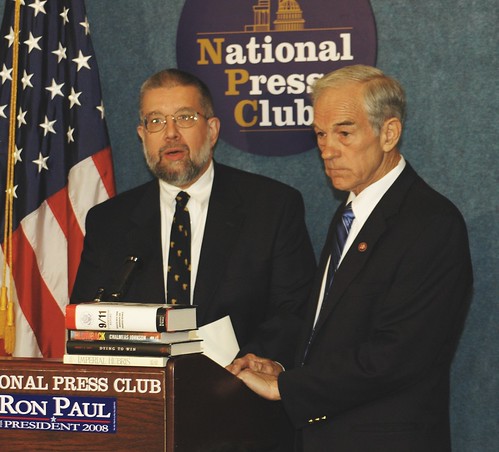
Good God. They really are wishing and hoping for a terrorist attack.Michael Scheuer, on Glenn Beck's show last night:
Scheuer: The only chance we have as a country right now is for Osama bin Laden to deploy and detonate a major weapon in the United States.Because it's going to take a grass-roots, bottom-up pressure. Because these politicians prize their office, prize the praise of the media and the Europeans. It's an absurd situation again. Only Osama can execute an attack which will force Americans to demand that their government protect them effectively, consistently, and with as much violence as necessary.
Beck: Which is why, I was thinking this weekend, if I were him, that would be the last thing I would do right now.
I guess the wingnuts have given up the pretense of decency and normalcy. Now they're rooting for another terrorist attack, so that we stoopid Americans will finally WAKE UP! to the nature of the evil that conspires against us ...
Actually, we're becoming quite awake indeed. And it isn't bin Laden who scares us right now. More like Glenn Beck and his guests.
from Ynet: Satmar family: No State involvement in son's funeral:
We hear a lot these days, from assorted boycotters and human rights campaigners, that there is no connection between anti-Zionism and antisemitism, that the two positions have as little to do with each other as supporting Manchester United has with a passion for philately.
It’s a pity the news didn’t reach the Mumbai terrorists before they murdered Aryeh Leib Teitelbaum. Had they known that he was neither a Zionist nor an Israeli, they would surely have asked him to step to one side as they conducted their slaughter. Or perhaps they did know, but Teitelbaum failed to clarify his political views fast enough to save his life. I mean, what’s an honest jihadi to do? In the heat of the moment mistakes get made.
Maybe the anti-Zionist human rights campaigners could get together to draw up a quick reference card for jihadis - to be carried with them when they set out on an operation - that would help them to rapidly distinguish those Jews who deserve to live from those who don’t.
Aryeh Leib Teitelbaum was a member of the family of the Satmar rebbe (read here).Hasid killed in Mumbai attacks recognized as terror victim by Israel, but his family begs government not to send representatives to funeral, cover his coffin with national flag, saying he belonged to anti-Zionist haredi stream.
The State has decided to recognize the Israelis murdered in the Mumbai terror attacks as victims of terrorism and pay for their funerals, but not all are happy with this decision. The family of slain Hasid Aryeh Leib Teitelbaum has informed the government that it would like the State not to intervene with his funeral.
According to a family member, "Holding a Zionist funeral for Teitelbaum, who was a Satmar Hasid, would desecrate the dead man's honor." The family demanded not to have a government representative at the funeral and that the casket, which will be flown into Israel today, would not be covered with the Israeli flag.
They also asked that Teitelbaum's body would be released immediately upon the plane's arrival, so that they would be able to hold an intimate funeral for him as soon as possible.
Shmuel Pfenheim of the Haredi Community anti-Zionist stream told Ynet: "I'm sending a message from the family. We don't want the State to meddle in our grief. Suddenly Israel has an interest to show the world that it is also a victim of global jihad, so it decides to throw a big ceremony with a coffin wrapped in a flag. We object to this. It pains us and offends our values."
'Not an envoy of the State'
Pfenheim, who attended the same yeshiva as Teitelbaum, added: "He wasn't killed as an envoy of the State or as a Zionist person. He simply went there as a kashrut supervisor on behalf of an American kashrut system. He himself was an American citizen, and although he was a resident in Israel he wasn't an Israeli national.
"The mere fact that he was living here, in a closed congregation, doesn't give the country permission to exploit his death.
Despite their protest, sources in the Haredi Community stressed that they did not plan to create havoc over the matter. "We are not like Neturei Karta. We conduct our struggles peacefully, and are simply begging the minister in charge and the police – the man has suffered enough. He's been there for almost a week. Let us bury him according to the family's will."

Yemeni President Ali Abdullah Saleh announced on Monday the dismantling ofHat tip:
a "terrorist cell" which he said was linked to Israeli intelligence services.Saleh gave no details but sources close to the investigation said he was apparently referring to a six-member cell arrested on suspicion of nvolvement in a deadly attack against the US embassy in the Yemeni capital last month.
"A terrorist cell was arrested five days ago and will be referred to the judicial authorities for its links with the Israeli intelligence services," Saleh was quoted as saying by the official Saba news agency.
He said the group operated under the "slogan of Islam."
The Yemeni president made the statement during a meeting with politicians, tribal leaders, security and military officials at Al-Mukalla University in the southeastern province of Hadramawt.
Saleh did not say how many people were arrested or detail his allegation that the cell was linked to Israeli intelligence.
"Details of the trial will be announced later," he told the gathering.
"You will hear about what goes on in the proceedings," Saleh said, urging Yemen's political parties to close ranks and cooperate to confront acts of terrorism, Saba reported.
Although Saleh said the group was arrested five days ago, sources close to the investigation told AFP he is believed to have been referring to six men rounded up in Sanaa after the September 17 attack on the US embassy which left 18 people dead.
Militants detonated a booby-trapped car before firing a volley of rockets at the heavily fortified embassy in the second attack targeting the mission since April.
The interior ministry said on September 22 that security forces were holding six key suspects over the attack, including an Islamist militant who claimed responsiblity for the strike.
"Security services succeeded in arresting six people, some of whom belong to Islamic Jihad, linked to Al-Qaeda and which claimed the attack," the ministry said in a statement.
"One of these people answers to the name of Abu Ghaith al-Yamani, who signed a statement claiming the attack," the ministry added.
The ministry said a total of 50 people were arrested in connection with the attack, in which six assailants were killed.
In Jerusalem, a spokesman for the Israeli foreign ministry called Saleh's accusations "totally ridiculous."
"To believe that Israel would create Islamist cells in Yemen is really far-fetched. This is yet another victory for the proponents of conspiracy theories," Igal Palmor told AFP.
In August, Yemeni security forces arrested five suspected Al-Qaeda militants in Hadramawt, days after the authorities revealed they had uncovered a new "terrorist" cell near the port city of Al-Mukalla.
Yemen, ancestral homeland of Al-Qaeda chief Osama bin Laden, has been battling suspected Al-Qaeda militants since before the September 11, 2001 attacks in the United States.
In recent months, the impoverished Arabian Peninsula country has seen a series of attacks on security services and oil installations claimed by groups linked to Al-Qaeda.
The latest was the attack on the US embassy, for which an Al-Qaeda-linked group, the Organisation of Islamic Jihad, claimed responsibility.
In October 2000, Al-Qaeda attacked an American warship, the USS Cole, off the southern port of Aden with a small boat packed with explosives, killing 17 American sailors.
Argentine President Cristina Fernandez asked Iran on Tuesday to hand over several citizens suspected of planning the deadly 1994 bombing of an Argentine Jewish center, so they can face a local trial.
"I would ask the Islamic Republic of Iran in accordance with international law...accept that Argentine justice can put on trial...those citizens who have been accused," Fernandez told the U.N. General Assembly in New York.
Argentina has asked for the arrest of former Iranian President Akbar Hashemi Rafsanjani, seven other Iranians and a former Hezbollah guerrilla leader on charges they masterminded the blast, which killed 85 people.
Interpol, the international police agency, has issued arrest orders for six of the suspects. Interpol notices seek the arrest of a suspect so that they can be extradited.
But they do not force a country to arrest a suspect.
Iran has repeatedly denied any involvement in the attack and blames the United States for trying to implicate the Islamic Republic.
Tehran has made an Interpol request for the arrest of five Argentines for making false charges against Iran and bribery.
The bombing of the AMIA Jewish center in Argentina came two years after an explosion destroyed the Israeli Embassy in Buenos Aires and killed 29 people. Neither crime has been solved.


Jews from around the world arrived on the Tunisian island of Djerba on Wednesday for an annual pilgrimage to Africa's oldest synagogue, with organisers expecting a significant jump in participants.
"Visitors have been arriving by the hundreds since Sunday to take advantage of a longer stay on the island, and there will be about 6,000 for the big day," organiser Perez Trabelsi said of Thursday's events at the Ghriba shrine.
They arrived amid heavy security, however, with authorities seeking to prevent an attack similar to the one carried out by a suicide bomber at the site in 2002 that killed 21 people.
Police set up barricades, while an electronic gate filtered visitors entering the area around the sacred site, believed to be 2,500 years old.
The total number of pilgrims in Djerba, which is popular with tourists, is expected to be 40 percent higher than last year, including a record 1,500 from Israel, said Trabelsi. The number of visitors dropped sharply after the 2002 attack.
Most, or some 4,000, will come from France, while others are due from Italy, Britain, Germany and Canada.
Tourism minister Khalil Laajimi was expected in Djerba to welcome the pilgrims and pay homage to Tunisia's Jewish community.
The Jewish community in Tunisia is still one of the largest in the Arab world but its numbers have dropped from 100,000 on independence from France in 1956 to round 1,500 today. Most emigrated to France or Israel.
Nearly half of those who remain live in Djerba.
The April 2002 attack just before the pilgrimage saw a suicide bomber ram the wall of the synagogue with a lorry laden with natural gas, which blew up killing 14 German tourists, five Tunisians and two French visitors.
The Al-Qaeda network claimed responsibility for the attack, which brought the flow of foreign pilgrims down from around 1,500 in 2001 to about 200 in 2002.
| |
| |
She sustained critical injuries from the impact and MDA paramedics alerted to the scene fought to resuscitate for some time before ultimately calling the time of death. Medics also treated a 50-year-old man for shock.
The al-Quds Brigades, the military wing of the Islamic Jihad, claimed responsibility for the deadly attack.
The trip to Yesha had not been planned. Katz had intended to meet with her sister-in-law, who was visiting from the US. But the two decided to relocate the reunion from Gvaram to Yesha after a Qassam barrage earlier in the day landed near the city of Ashkelon - which is near Gvaram.
Katz had been waiting outside one of the houses while her son went inside to determine if they had found the right address. Seconds after the rocket alert sirens sounded the Qassam struck a mere dozen inches from her.
Qassams rain on
Earlier on Monday several Qassams were fired from northern Gaza towards Israel, one landed near an elementary school in Ashkelon. A number of buildings were damaged but no injuries were reported.
Yesha council chairman, Yehuda Madmon, told Ynet the rocket alert sirens had sounded prior to the impact. "There was the 'Color Red' alert and I had a very bad feeling. This is the first time I have run for cover from a Qassam. All of a sudden there was a horrendous blast," he said.
Sajed Aziz told the court on the first day of his trial that he and Zalman Gurevitch, 43, first had a testy verbal exchange on a street in the city in September. Then the orthodox Jewish rabbi grabbed him by the collar of his jacket and screamed at him, Aziz testified.
He said he reacted by pulling a knife and stabbing at the rabbi, but insisted he could not recall what had happened next. Aziz testified he later looked at the knife, but did not see any blood on it.
Prosecutors have said the rabbi — who suffered stab wounds from the incident — told authorities at the time of the attack that his assailant said, "I'll kill you, you (expletive) Jew," then pulled out a knife with a 7.6-centimeter (3-inch) blade and stabbed him in the stomach.
A German citizen born of Afghan parents, Aziz is charged with attempted manslaughter, dangerous bodily harm and invasion of privacy. He has denied that the attack had an anti-Semitic motive or that he intended to kill the rabbi.
The young man apologized to Gurevitch at the opening of the trial.
Aziz, who told the court that on the day of the attack he had woken up at noon and then smoked several joints to improve his mood, has been held in custody since his arrest due to his criminal record, which includes another case of causing bodily harm.
The attack prompted concern and condemnation from local politicians and Jewish groups.
A verdict in the trial is expected on May 17.

An authoritative new report by Policy Exchange, the UK's leading centre-right thinktank, entitled The Hijacking of British Islam: How extremist literature is subverting Britain's mosques, reveals the worrying extent of extremist penetration of mosques and other key institutions of the British Muslim community. The report is the most comprehensive academic survey of its kind ever produced in the UK and is based on a year-long investigation by several teams of specialist researchers into the availability of extremist literature and covers more than a hundred mosques and Islamic centres throughout the UK.
Among the reports findings are:
Shocking statements
Pamphlets, books and leaflets obtained from mosques and Islamic centres contain an assortment of shocking statements including:
Although some of the hate literature is in English, a proportion is written in Arabic. The translations commissioned by Policy Exchange have been independently verified.
Many of the publications encourage British Muslims to segregate themselves from non-Muslims. So-called unbelievers are to be treated as second-class and avoided wherever possible.
There are also repeated calls for gays to be thrown from mountains and tall buildings and for women to be subjugated.
Among the literature available are extracts from the notorious anti-Semitic forgery, The Protocols of the Learned Elders of Zion (published by the Saudi Ministry of Education), and other publications peddling bizarre conspiracy theories alleging that birth control is a plot against Muslims and Arabs, and that pornography is spread as part of a Jewish plot to corrupt Muslims.
The report has been authored by Dr Denis MacEoin, the Royal Literary Fund Fellow at Newcastle University who received his doctorate in Persian (Islamic) Studies from Cambridge University and has taught Arabic and Islamic Studies at Durham, Newcastle and Fez universities.
Speaking about the findings of the report, Anthony Browne, Director of Policy Exchange said, "It is clearly intolerable that hate literature is peddled at some British mosques. I am sure the majority of moderate Muslims will be as horrified as everyone else that pamphlets advocating jihad by force, hatred for insufficiently observant Muslims, Christians and Jews, and segregation have found their way into the UK's mosques."
Mr Browne went on to say, "The fact that the Saudi regime is producing extremist propaganda and targeting it at British Muslims must also be challenged by our own government. It is reassuring that the majority of mosques investigated do not propagate hate literature - but much work needs to be done to ensure that a large number of leading Islamic institutions remove this sectarianism from their midst."
Recommendations
The report makes several key recommendations:
i)The Saudi Arabian government must be told to stop distributing extremist literature in Britain or else risk its good relations. King Abdullah of Saudi Arabia is currently on a state visit to the UK and the British government should address this matter directly with him.
ii)Mosques and other Islamic institutions must act immediately to remove extremist literature from their premises.
iii)The government, local authorities, police forces, other institutions and prominent individuals should have nothing to do with mosques that continue to sell or distribute extremist literature.
iv)Islamic schools must be subject to clear and rigorous regulation and made part of a genuinely shared system of national education.
At the urging of the American Library Association’s Office for Intellectual Freedom (OIF), a scholarly book pulped by its British publisher is maintaining a safe haven in U.S. libraries. Alms for Jihad was the target of a potential libel suit in England by Sheikh Khalid bin Mahfouz, whose charitable activities have reportedly been linked to terrorist activities, as conveyed in the book. In response, publisher Cambridge University Press (CUP) pulped its unsold copies of the book, put it out of print, asked libraries to pull it, and agreed to pay damages. CUP also issued a stunning public apology on its web site in which it characterized the "serious and defamatory allegations" against Mahfouz in Alms for Jihad as "manifestly false."In a statement released last week, the OIF recommended libraries resist Cambridge’s request. Libraries "are under no legal obligation to return or destroy the book," said OIF deputy director Deborah Caldwell-Stone. "Libraries are considered to hold title to the individual copy or copies. Given the intense interest in the book, and the desire of readers to learn about the controversy firsthand, we recommend that U.S. libraries keep the book available for their users."
As of mid-August, Alms for Jihad was not available through Amazon.com, Barnes & Noble, or Alibris. (About 1500 copies of the book were sold worldwide.) Libraries suddenly have an incredibly rare book in their stacks; a WorldCat search finds the book at nearly 300 libraries. Rather than discard the book, many libraries are safeguarding it, keeping it on hold, at the reserves desk. "I have recalled the copy of this title…in order to place it in our Rare Books collection, where it may be read by anyone but not borrowed," said Dona Straley, Middle East Studies librarian at Ohio State University's Ackerman Library. "Several of my colleagues at other institutions have reported their copies as missing."
That may be the case at University of North Carolina's Davis Library, whose catalog reveals that Alms for Jihad is "in search," meaning "someone has gone to the shelf to look for the book and not found it," said reference librarian Carol Tobin.
These sorts of measures may eventually be less necessary, because the authors hope to republish Alms for Jihad in the U.S. Co-author Robert O. Collins, a professor at University of California Santa Barbara, told LJ that he and co-author J. Millard Burr, a former state department employee, are currently negotiating with CUP for a rights reversion. The authors have had several offers from U.S. publishers.
"We stand by what we wrote and refused to be a party to the settlement," Collins said. "As soon as CUP received notice, they decided to settle as rapidly as possible despite our vigorous defense. CUP did not want to embark on a long and expensive suit which they could not win under English libel law." Indeed, libel laws in England are far more favorable to plaintiffs than those in the U.S.
Collins said he is confident Alms for Jihad will be republished in the U.S., where Mahfouz's charges would have little chance of succeeding in court. "In reality, the few passages referring to Mahfouz are trivial when compared to the enormous amount of information in the book that is in demand," Collins noted, adding that he has received calls from booksellers offering as much as $500 for copies.
Attorneys have an effective new way to defeat Islamic groups’ libel suits.
Nothing gets a journalist’s attention like a subpoena. While authoritarian regimes silence critics by murdering or jailing them, journalists (and other critics) in the United States face gentler, but still effective, intimidation: libel lawsuits. Over the last few years, Islamists have tried silencing reporters, scholars, and citizens by suing them for defamation, often successfully. But recent legal cases in California, Massachusetts, and Minnesota suggest that the tactic may finally be backfiring, at least in the United States, if not in Britain, where libel laws overwhelmingly favor plaintiffs. The American lawsuits’ outcomes—poorly covered by the media—represent victories for the free expression and public participation that the First Amendment guarantees.
The latest victory came in August, when an Islamic charity, KinderUSA, and its board chairman, Laila Al-Marayati, dropped the libel suit they had filed in April in California state court against former Treasury Department official Matthew Levitt, the Washington Institute for Near East Policy (which now employs him), and Yale University Press. In 2006, Yale published Levitt’s book on Hamas, which Washington says supports terrorism. Levitt never mentioned Al-Marayati in his book, but he did assert that KinderUSA, founded to raise money for Palestinian children, had ties to terrorist groups.
Al-Marayati and KinderUSA charged that Levitt had made “false and damaging” charges that caused “irreparable harm to its reputation,” and they sought at least $500,000 in damages, a public retraction, and a halt to the book’s distribution. But Levitt and his codefendants stood by his claims. In June, they filed a motion against the charity and its chairman, seeking to quash the libel suit and demanding that the plaintiffs pay all legal fees. They cited a California law that bans “SLAPP”—or “strategic litigation against public participation”—suits, which aim not at winning in court, but at intimidating into silence a group or a publication raising issues of public concern. “California enacted anti-SLAPP legislation to get rid of inappropriate lawsuits like this one,” they wrote in a 15-page brief.
Less than six weeks later, Al-Marayati and KinderUSA dropped the suit. Todd Gallinger, who represented the plaintiffs, insisted that the charity had sued not to intimidate or silence Levitt, but rather to force him to correct charges that it still considers libelous. “They were trying to suppress the charity’s legitimate activities,” he said. But KinderUSA underestimated the costs involved, he acknowledged, and the defendants’ anti-SLAPP motion was a factor in its decision to drop the suit.
“Anti-SLAPP laws are a very powerful tool,” agreed Roger Myers, an attorney who specializes in using the law to defend journalists in libel claims. “There has been a fairly dramatic decline in the number of libel cases being filed here in California.”
Levitt’s case isn’t unique. Last May, the Islamic Society of Boston dropped its suit against the Boston Herald, a local Fox news channel, journalist Steven Emerson, and 14 others. The Society had accused the defendants of libel and of infringing its civil rights by claiming that it had funded terrorist organizations, received money from Saudi Arabia, and bought land for a mosque below market value from the City of Boston.
Though Massachusetts’s anti-SLAPP law does not cover media firms, ten of the non-media defendants filed a motion to quash the Society’s suit. When a state judge rejected the motion, a legal discovery process got under way while the defendants appealed. Bank records and other documents revealed that, contrary to its claims, the Society had raised over $7 million from Saudi and other Middle Eastern sources and had funded two groups that the Bush administration has designated terrorist entities: the Holy Land Foundation for Relief and Development and the Benevolence International Foundation. Records also showed that Society directors had deleted all e-mails about the Society’s land purchase. Finally, discovery revealed that the deputy director of the Boston city agency in charge of negotiating the land deal not only was a Society member whom it had paid to raise money in the Middle East, but also secretly advised the group about obtaining the land cheaply—a clear conflict of interest.
On May 29, soon after the state appellate court heard arguments on the anti-SLAPP appeal, the Society abandoned the suit. Though its lawyers did not respond to requests for comment and its website tried to put a good face on the surrender, Jeff Robbins, who represented several defendants in the complex lawsuit, expressed their belief that the Society had caved, fearing the prospect of paying what could have been millions of dollars in court and legal fees. “The anti-SLAPP motion clearly played a role,” said Robbins, who represented two clients for free because First Amendment issues were involved. Another factor, he said, was the Society’s fear that the court would order it to answer questions under oath and release information that it had tried to keep secret, such as the names of its donors. The case shows that while anti-SLAPP legislation makes it somewhat easier, cheaper, and faster for those accused of libel to fight back, “it doesn’t solve the problem entirely,” said Jeff Hermes, a lawyer for the Boston Herald. “Media companies are not covered by our state’s statute, and defendants in such cases still need to prepare a full defense.”
In Minnesota, a third lawsuit didn’t involve journalists or SLAPP statutes, but it did threaten citizens’ right to petition or warn the government on public safety issues. It also prompted Congress to protect people retroactively who report suspicious behavior. The defendants were anonymous citizens whose complaints about what they considered suspicious behavior by six Muslim imams on a flight in late 2006 led US Airways to remove the clerics from the plane. In a 2007 federal lawsuit claiming discrimination, the imams sued the airline, the Minneapolis airport, and several of the passengers who had complained.
But in August 2007, the “flying imams” dropped all claims against the passengers after Congress approved legislation to protect passengers from retaliatory lawsuits for reporting potentially terror-related activity. Under the measure, as in an anti-SLAPP law, if the plaintiffs cannot prove that a passenger lied in his complaint to the government, they can be held responsible for all court and legal fees. “The imams saw the handwriting on the wall,” said Representative Peter King, the New York Republican who promoted the bill. Gerry Nolting, a lawyer who represented a passenger, also without a fee, said that the imams might never have filed their suit if Minnesota had on its books an anti-SLAPP law like California’s.
However intimidating and expensive defamation lawsuits remain in the United States, the challenge is far greater in Britain, where journalists must prove that their allegations are true. Rachel Ehrenfeld, a New York–based terrorism researcher and the author of Funding Evil, is among more than 30 writers and publishers whom Saudi billionaire Khalid bin Mahfouz sued for libel in England for accusing him of ties to terrorist groups, a charge he denies. But rather than give him the apology, retraction, and $225,000 in fees that a British court ordered, Ehrenfeld, whose book was never even published in England, fought back. In 2004, she countersued bin Mahfouz in New York, asking the federal court here to declare the judgment against her unenforceable in America and contrary to the First Amendment protections that Americans enjoy.
In June, the Second Circuit Court of Appeals, overturning a lower court ruling, asked the state’s highest court to determine whether bin Mahfouz should be subject to New York jurisdiction. If it rules affirmatively, Ehrenfeld would be able to obtain considerable information about his finances in preparing for a trial. If he then failed to cooperate, he might have difficulty doing business in America.
Ehrenfeld’s effort comes none too soon, says Andrew McCarthy, a former federal prosecutor, for bin Mahfouz no longer needs to sue to intimidate his critics. After he merely threatened Cambridge University Press with a libel suit this spring, the prestigious publisher agreed to apologize on its website, pay his legal costs and unspecified damages, and stop distributing Alms for Jihad, a book written by J. Millard Burr, a former State Department analyst and relief coordinator, and Robert O. Collins, a former University of California history professor, which outlines bin Mahfouz’s alleged financial support for terrorism. Cambridge also asked libraries to remove the book from their shelves. On its website, Cambridge states that it took such steps because “under English libel laws, we simply did not have a defensible case.” A court victory for Rachel Ehrenfeld, and more anti-SLAPP statutes—only some 20 states have enacted such laws—would help curb the pernicious “libel tourism” so inimical to the free flow of information on which an informed citizenry and effective counterterrorism depend.


