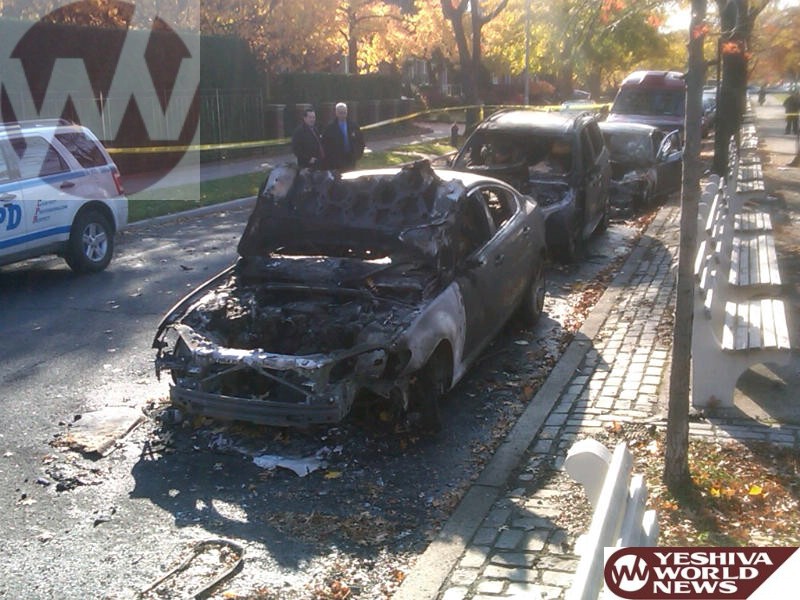
More here, including video of the fires: Car Fires, Anti-Semitic Graffiti Put Brooklyn Neighborhood On Edge - NY1.com

(C)ongress isn’t making any laws about the matter so that settles that. Thank you Mr. Assistant Professor in Chief. Unfortunately there is nothing in there preventing the president from insulting the intelligence of the public.
Consider the non-smoking rules so dear to (New York City Mayor) Bloomberg’s heart. There are people, loud persistent people, in NYC that don’t like cigarette smoke. And based on that dislike — a mere dislike — property owners, leasors and leasees of all sorts around NYC must prevent their customers from smoking on their property or face the wrath of the city. Property rights in NYC are such that hanging a sign over your door that says “Smokers Only” will not defend you. You have no say in the matter, your rights are not recognized. And that is only one, blatantly obvious example.
NYC is very well practiced at limiting one person’s rights to accomodate the comforts of another.
Public property in NYC is handled with the same high handed flippancy, as if it belonged personally to New Yorkers’ alleged representatives. For example, traffic down Broadway is now slowed to a trickle, because some genius in the administration thought it would be nice to have little parks in the middle of Broadway rather than all those nasty smelly cars. The rights of the public that jointly own that avenue? Not even a consideration.
And here again, why make little parks in the middle of one of NYC’s busiest streets? Because little parks appeal to somebody’s feelings, whereas cars do not.
To be fair, some might argue, perhaps even with some justice, that that is just what local ordinances are for. To legislate matters that in an ideal sense, impinge on individual rights, for the sake of accomodating local sensibilities. But, were that correct, the Bloomberg administration would only stand more deeply damned.
Bloomberg and his functionaries could have found a dozen, perfectly plausible and normal ways to dictate that the mosque could not be built less than than some arbitrary distance from ground zero. They have all the tools they need.
The government of NYC and Mr. Bloomberg, can, will and do legislate and regulate on the basis of feeling. The only question is whose feelings. What we learn is that the feelings of most of the voting public, indeed the feelings of the families of the dead and survivors of the 9/11 attack, do not count. What matters are the feelings of Mr. Bloomberg and his leftist friends.
And believe me when I tell you, those are not feelings of love. Not for America. And not, gentle reader, for you.


Blogger Adam Holland has received an email from Congregation Beth Elohim in Brooklyn, where his family attends services and where his 4-year-old son attends preschool:
The email concerns plans by a hate-group to demonstrate outside the synagogue. I’ve written frequently about anti-Semitism on my blog for the past three years. Now it has come to my doorstep and demanded my attention and the attention of those who care about this issue.
The group in question, Westboro Baptist Church of Topeka, Kansas, has a long history of demonstrating at gay pride events with signs and slogans of the lowest, most hateful kind. More recently, they have similarly targeted the funerals of those killed in combat in Iraq and Afghanistan. Now they target Jewish religious services as well. I’m asking those with the capacity to speak out against the efforts of Westboro Baptist Church to harm Jews, gays, and members of the military to do so now.
As I wrote on my blog, Westboro Baptist demonstrated outside Rosh Hashana services in Norman, Oklahoma, last Saturday bearing signs reading “God hates Jews”. No Jewish child should be forced to read that sign. No family should have to explain to their child what that sign means. Our families should not be forced to run a gauntlet of bigots in order to worship. By exposing this sort of hatred, and by demonstrating our commitment to peaceful coexistence between all religions, we help to counter those who try to sow seeds of hate.
You may recall that the same group demonstrated outside my old high school last spring because it’s named after the notorious homosexual Walt Whitman.


“Mugabe is right, U.S. hands-off Zimbabwe” was the headline that caught my eye when a friend gave me a flyer which she picked from the Abyssinian Church in Harlem, New York. On the flyer was the name of an organization, the December 12th Movement. A telephone number was listed and I called it. When a woman answered the phone I asked her to clarify what the flyer meant.
“We are having an event on Thursday July 3rd at 6.30pm” she advised, somewhat impatiently. “Come there and you will find out what we mean.” The line went dead.
Prior to this incident, I had watched and listened with horror to the news coverage of Zimbabwe over the last three months. Most of my news sources have been family, relatives and friends in Zimbabwe as well as online newspapers run by Zimbabweans, because only state run newspapers are allowed in today’s Zimbabwe. They informed me that most schools in the countryside outside the cities were deserted as the teachers had fled. Teachers were being targeted for brutal victimisation by President Robert Mugabe’s Zanu-PF party.
Some of them had acted as polling agents in the March 29 elections, which Mugabe lost. I read the heartbreaking story of a headmaster who, fearing for his life had fled the school, but had returned after being assured of his safety. A week after his return, he was kidnapped by Zanu-PF militiamen. After two days, his worried wife found his Identity card, tie, shoes, and pair of trousers on the veranda of their home.
She went to the police and was told to go to the local mortuary. His body was there. I have seen pictures of people with their faces smashed in, their backs raw and bones sticking out. I read about people whose homes had been burned; people who had been murdered in cold blood.
Though these events were taking place far away back in Zimbabwe, the stories were real to me because the names of the victims were familiar. These are names that, no matter where they are in the world, if Zimbabweans hear such names they immediately recognise them.
But in the comfort of my life here in New York, I thought I could switch on and off the horrific drama that was unfolding in Zimbabwe when it suited me. Then a week ago I received a phone call that my elderly parents in their seventies had been beaten up by the notorious Zanu-PF youths, led by members of the army. Mugabe’s war had come too close to home. I was distraught with worry.
I spent sleepless nights calling my sisters back at home, trying to persuade them to go to our rural village. They were reluctant to go, because in the rural areas far from the prying eyes of the world, Zanu-PF’s militiamen were unleashing an orgy of violence and intimidation. The rural peasants were reliving the Chimurenga War of the 1970s. People were being rounded up and made to sing war songs. The opposition supporters (MDC) were paraded and forced to take turns beating each other up.
In our village, they went around beating up everyone, including a Mugabe supporter, my father. My father’s philosophy is simple. If people don’t vote for Mugabe, there will be war again. In past elections I threatened to withdraw the money that I sent home. Then I threatened not to speak to him if he went ahead and voted for Mugabe. But, when he became seriously ill and needed surgery, I forked out the US$500.00 required.
I have at my disposal in New York many news sources out of Zimbabwe. I remember telling my sisters on the phone that I had seen Tsvangirai’s new red campaign bus. I also told them of incidents that had happened outside Harare, which they did not know about. My family’s knowledge of what’s happening in Zimbabwe has been limited to what is passed on to them by word of mouth. Sometimes they will find out what happened weeks after an incident took place - like the beating of our sister-in-law’s cousin and his wife (both teachers) and their son.When my sisters visited our sister-in-law they found out that she had just arrived from visiting the trio in hospital. They are still in hospital today, more than a month after the vicious assault.
It was against this background that I was driven by curiosity to find out who these supporters of Mugabe in New York were. I asked a friend who has a video camera to come along with me. My idea was not only to find out the identity of these supporters but also to capture them on video.When we arrived at the Abyssinian Church the event was already in progress. The room was packed . . . I turned to the man seated next to me and asked him how he had found out about the meeting. He . . . pulled out a letter from WBAI. “I am a member,” he said with a grin.
I took the form from him. It was from WBAI, requesting members to send contributions. I handed it back to him.
“Don’t you listen to WBAI?” he asked me. “That’s where I got the information about this event, they announced it.”Sure enough, I noticed something that had not occurred to me before. Most of the audience comprised WBAI listeners. I did an internship at the station a few years ago. WBAI . . . relies on contributions from listeners. These members have a lot of control over the program and if they don’t like what they hear, they call up to complain. When I went on air to read international news, which included reports about the bloody land invasions in Zimbabwe, the listeners called the station soon after I came off air. They called me names. . . .
(P)residing over . . . Thursday’s meeting was one Viola Plummer. She rallied against Human Rights Watch (and) Amnesty International, accusing them of supporting the opposition Movement for Democratic Change in Zimbabwe. The MDC, she told her audience, was a front of the white people.
When a young black reporter asked her why Mugabe had banned all the NGOs, she replied that they were distributing food as well as the opposition pamphlets. What about Save the Children (UNCEF), the reporter asked. “They are all the same,” Plummer said, “including CARE.
As her audience cheered her on, she vowed to fight to the death. Trade unions in Zimbabwe were the most racist, she declared. The Zimbabwe Congress of Trade Unions, of which Morgan Tsvangirai was secretary general, has an almost exclusively black membership. Plummer claimed that the international organizations in Zimbabwe were funded by the Bush administration and the British government.
To the people of Zimbabwe, Viola is a foreign dignitary. Over the last several years, she and her entourage have been the guests of Robert Mugabe’s government. In his book, Against the Grain, Geoffrey Nyarota [read here] says as Zanu-PF’s circle of friends in the international community diminished, the December 12 Movement of Harlem in New York shot to prominence in Harare.
“The head of the movement acquired an avant-garde name, Comrade Coltrane Chimurenga, to reinforce his revolutionary credentials,” Nyarota says. “Comrade Chimurenga and one Sister Viola Plummer undertook an annual pilgrimage from Harlem to Harare, their visits timed to coincide with Zimbabwe’s independence celebrations on April 18.
“The delegation from Harlem was flown across the Atlantic and accommodated in the five-star Sheraton Hotel at taxpayers’ expense. After being feted, entertained and flown to exotic tourist attractions like the Victoria Falls, they were paraded at the Independence Day festivities.
“They inevitably granted so-called exclusive interviews to the Herald, the Sunday Mail and the Zimbabwe Broadcasting Corporation’s radio and television channels in which they extolled the virtues of the ruling party and the allegedly profound wisdom of its leaders. They told Zimbabwe’s long-suffering taxpayers what a good job their President was doing for the nation and urged them to support Zanu-PF unflinchingly.
“Soon after the land invasions in 2000, Comrade Chimurenga was quoted by the government media as having unreservedly endorsed the ‘Third Chimurenga’, or Third Revolution, whose centrepiece was the violent occupation of white-owned farms. In New York, Mugabe relied on the December 12 Movement to organise an occasional demonstration, even at short notice - rent-a-crowd events, as Bill Saidi aptly summed up their timely interventions - in support of Zimbabwe’s President and government.”
An editorial in the June 12, 2007, issue of the New York Daily News has this to say of Plummer. “Who is Viola Plummer? Let’s go to the record. In 1985, she stood trial with seven co-defendants on charges of plotting to crash out of prison two members of the gang that pulled off the 1981 Brink’s armored car robbery in which a guard and two cops were killed in Rockland County. “Acquitted of the most serious charges, other members of the group, including Plummer’s son Robert Taylor, were convicted of possessing weapons such as dynamite and machine guns. In the transcript of an undercover recording introduced at the trial, a leader of the bunch, Coltrane Chimurenga, instructed Taylor in the ways of armed robbery.”
As she angrily rallied against white injustice here and abroad last Thursday, her audience cheered and clapped their hands. She characterised what was happening in Zimbabwe as white retaliation for the land invasions. Some in the audience were wearing Zanu-PF T-shirts with the campaign message: “100% empowerment, VOTE for Mugabe.”
But the people of Zimbabwe, including her contacts in Zanu-PF do not seem to know who Viola Plummer really is? Viola Plummer is a former aide to councilman Charles Barron, who is also known as a former member of the Black Panther Movement. She was fired by New York City Council Speaker Christina Queen after she threatened to assassinate a New York City councilor over a legislative dispute. The (threatened) councillor had refused to support her measure to have a street renamed after a black activist called Sonny Carson.
Prior to this incident, Viola Plummer went on trial after being accused of trying to stage the jail break-in to free two fellow activists who had been jailed for their involvement in the1981 Rockland County robbery. Plummer ended up only being convicted of falsely identifying herself to the police.
Plummer was in Zimbabwe during the independence celebrations this year and prior to the June 27 presidential runoff. At the meeting, she said she had attended the inauguration of Mugabe in Harare on Sunday, June 29.
THE December 12 Movement, one of the foreign observer missions that witnessed the June 27 presidential run-off election, has endorsed the poll as an expression of the will of the people of Zimbabwe.
The African-American organisation, based in New York in the United States, however, said the existence of sanctions and the disproportionate and biased reporting of what was taking place in Zimbabwe by a few media outlets with global outreach had skewed the playing field against Zanu-PF. Members of the mission yesterday said their findings so far indicated that the poll outcome was not only a free expression of the will of Zimbabweans, but that it set an example for the rest of Africa and the Africans in the Diaspora.
Omowale Clay: I have something very important to report to the Pacifica community in general and to African people, in particular. Yesterday the people of Zimbabwe resoundingly said they will never be a colony again. Unofficial results have confirmed that Zanu PF has won a major victory, and by all counts will in fact capture over 2/3 of the electoral vote, which will give them the ability to restructure their constitution, to institutionalize the [inaudible] which was always the view of them fighting for the total emancipation of their people politically and economically. So I wanted to make sure to bring back the people, to also let them know, Amy, that democracy in Zimbabwe is not anything new. For the past 25 years as we celebrate the 25th silver jubilee, democracy was brought to Zimbabwe through national liberation armed struggle and it was never given to the Zimbawean people. But since 1980 when the first elections took place, there have been six major parliamentary elections that have taken place, and there have been three presidential elections that have taken place. So no one can teach Zimbabwe democracy. Zimbabwe is teaching it to the African and pan-African world, as well as to the neo-colonizers who are trying to re-colonize Zimbabwe.
Assembly member Inez Barron has selected Viola Plummer to join her staff. Ms. Barron made the announcement during her judicial swearing-in ceremony at the House of the Lord Church. Ms. Plummer, who served as Chief of Staff with Council member Charles Barron, will work in Assembly member Inez Barron's 40th AD district office. Ms. Barron has also selected Mel Faulkner to staff the district office. Mr. Faulkner has worked in Council member Barron's district office.
The announcement was made during the first of 2 consecutive ceremonies celebrating Ms. Barron's new position. Judge Sylvia Ash gave Assembly member Barron the Oath of Office at both events - first at the House of the Lord Church, then later that evening at St. Paul's Community Baptist Church. Rev. Herbert Daughtry gave a historical perspective of community activism and electoral politics. Councilman Charles Barron spoke of his love and support for his wife.
Elected officials in attendance at the events were Judge Geraldine Picket, Assembly members Annette Robinson, Karim Camara, and Michael Gianaris, State Senators Eric Adams and Bill Perkins, Council members Letitia James, Bill DiBlasio, and Eric Gioia. Others who came to witness Ms. Barron's oath were family members and a variety of community leaders: Dr. James McIntosh, Faye Moore (Local 371 Public Sector Social Service Workers), David Galarza (CSEA Local 1000), Ms. Ollie McClean, Dr. Ron Daniels and his wife Mary France, Sam Anderson, Kevin Powell, Stan Kinard and his wife Tulani (candidate for the 41st Council seat), Bob Law, Dr. Lenora Fulani, and Brenda Walker.
Special acknowledgements were made to those who assisted in getting Ms. Barron elected: Paul Washington (Inez Barron's Campaign Manager) and his wife Peggy, Andre Mitchell, founder of Man Up, Inc. and Hip Hop SUV (Stand Up and Vote), December 12 Movement, Operation Power, the United African Movement, and the Coalition of the Outsiders.
Noted at both events was the history made: a siting council member and assembly member husband- wife team covering the same geographic area at the same time.
(The City Council honoring Mugabe) was the inspiration of Councilman Charles Barron, and his Chief of Staff, Mr. Paul Washington, whom Barron calls his "Comrade in Struggle and Co-Council Member," brought it to fruition.
Charles Barron is intent on running his former chief-of-staff (Paul Washington) to replace him after he is term-limited from his seat in the council.

The case brought against the city and Council Speaker Christine Quinn by Councilman Charles Barron's ex-chief of staff, Viola Plummer, in the wake of the 2007 Sonny Carson street re-naming flap is one step away from being dismissed.
The US Court of Appeals for the Second Circuit issued a ruling today that overturned a lower court decision denying immunity to Quinn on Plummer's claim that the speaker's decision to fire her violated her First Amendment rights and ordered the case remanded for dismissal.
The decision note the city's burden in making its case was lower due to Plummer's status as a high-ranking public employee and the fact that her use of the word "assassination" in connection with Councilman Leroy Comrie sparked a reasonable concern for his safety in Quinn, given the 2003 muder of Councilman James Davis."The First Amendment does not require employers to sit idly by when an employee engenders such concerns. In view of these two incidents of “disruption,” taken together, and because we conclude that there is no genuine issue as to whether Quinn’s actions were taken in retaliation for Plummer’s speech...For these reasons, we hold that Plummer’s First Amendment rights were not violated and enter summary judgment for Quinn and the City of New York."
According to an attorney in the city's Law Department, unless Plummer decides to appeal, the case will end here.
I reached Plummer at her new job as director of operations in Assemblywoman Inez Barron's office. She hadn't yet heard of the ruling, and thus couldn't comment on what her plans might be.NOTE: The decision is by three judges: Circuit Judges Rosemary Pooler and Debra Ann Livingston and District Judge Jed Rakoff.
A crowd of more than 300 Hasidic Jews, some shouting “We want justice!” marched in Crown Heights, Brooklyn, on Friday afternoon to protest the assault and robbery of a Jewish teenager early that morning.
The protesters marched from the scene of the assault, at Empire Boulevard and Albany Avenue, to the 71st Precinct station, and then up New York Avenue to Eastern Parkway, where they blocked traffic. They were briefly stopped at Kingston Avenue by a line of police officers who stood arm to arm.
Traffic was reopened on Eastern Parkway at 6:10 p.m., and the crowd gradually dispersed around 6:45 p.m.
According to the police, the teenager, 16, left his house in Crown Heights around 12:10 a.m. on Friday and was attacked and robbed a short while later. He sustained a concussion and cuts on his face and hands, and his bicycle, watch and cellphone were stolen, the police said.
The beating of the teenager, identified by the protesters as Alon Sherman, is being investigated as a possible hate crime, and officers are looking for witnesses, the police said.
The protest was an outburst of tension in a neighborhood that erupted in 1991 with unrest and violence among Jews and blacks, who have coexisted in the area, usually peacefully, for decades.
Recently, black leaders expressed anger after a 20-year-old black college student, Andrew Charles, was attacked in the neighborhood on April 14 by two Jewish men, in what the police have described as a hate crime. On Friday, the police released a photograph of a man, Yitzhak Shuchat, 25, who is being sought as a “person of interest” in the attack on Mr. Charles.
Police Commissioner Raymond W. Kelly said at a news conference Friday morning that the police were investigating reports that Mr. Shuchat was a member of an unofficial Hasidic security group.
“There has been talk of a group that is not officially sanctioned or recognized,” he said. “If that is the case, we certainly frown on that.”
New York City Police Commissioner Ray Kelly visited The Schluchim Center Monday night to talk with local Jewish leaders about the recent rise in racial attacks.
People who met with Commissioner Kelly say the message they wanted to get across is that the incidents aren't a Jewish issue or a black issue, but a problem facing the entire community.
“We are happy he came but we're still concerned the police department isn't realizing the severity of the situation,” says Rabbi Yosef Jacobson.
Commissioner Kelly listened to concerns and noted that crime was lower now than it was in the 1990s.
Rabbi Jacobson says the most recent attack occurred Saturday night when members of his congregation were attacked while walking home from a Sabbath meal. Additional incidents involved a Jewish teen allegedly being beaten and attacked on Friday and a young black teen allegedly attacked by a group of Jewish men last month.
Outraged by a continuing series of violent attacks against Jews in Crown Heights, hundreds of protesters from the Chabad-Lubavitch community rallied last Friday in the Brooklyn neighborhood outside the local police precinct calling for a greater police presence and the ouster of the precinct commander.
Three days later, Police Commissioner Raymond Kelly visited the neighborhood and held an impromptu meeting with community leaders. The next day, the leaders reported a heavier police presence, including two mobile observation towers and three commander posts, and a chasidic blog reported that the commander, deputy Inspector Frank Vega of the 71st Precinct, was being transferred.
The report was denied by the NYPD’s top spokesman.
Crown Heights leaders on Tuesday also met with Deputy Mayor Edward Skyler to discuss their concerns.
The protests followed the attack on 16-year-old Alon Sherman early Friday morning, which left him unconscious. He was robbed of his bicycle and other possessions.
That attack was followed by another incident Sunday. Witnesses said three young black men threw rocks and shouted anti-Semitic slurs at Jewish pedestrians outside a synagogue on Eastern Parkway. Last week, a school bus full of children from a chasidic school was pelted with rocks thrown by an estimated 10 youths on President Street.
All this takes place against the backdrop of a police manhunt for assailants in the April 14 assault on a black college student in which the assailants are said to be volunteers in a chasidic patrol group. District Attorney Charles J. Hynes has convened an investigative grand jury to probe that incident, and police identified Yitzchak Shuhat, 25, an emergency medical technician, volunteer patrolman and former NYPD auxiliary officer, as someone wanted for questioning.
“This is creating outrage and disgust among the Jewish community,” said Yossie Stern, chairman of the Shmira Patrol, which was implicated by Hynes in the incident. “There have been close to 40 beatings [of Jews] in the past and not one single arrest. People are very angry at the police department and shocked that in the end, reaction to this one isolated incident tells the Jewish community that they are not acting fairly.”
Tensions are also reportedly building between Shmira and its rival, the Shomrim patrol group, from which it separated more than a decade ago. Anonymous bloggers continue to launch personal attacks against Stern and other members by name, accusing them of the halachic transgression of mesirah, turning a Jew over to secular authorities, in an unrelated incident last year.
During Kelly’s visit to Crown Heights Monday night he told chasidic leaders that the neighborhood is safer than it has been in 20 years. In a video posted on a Chabad Web site, Kelly is seen arguing that point with a local rabbi, Yosi Jacobson. In that argument Kelly seems to allude to Shmira, whose members were referred to by Hynes as “renegades” whose work is unsanctioned by the community and the police.
“We need calm heads, cool heads,” says Kelly in the footage. “We don’t want people irrationally causing problems.”
Black and Jewish elected officials and community leaders were to gather on Thursday to discuss obtaining funding to post more video surveillance equipment on streets where attacks have taken place , in order to help deter crime and identify culprits.
“We need to restore confidence and security on the streets,” said Councilwoman Letitia James, who represents Crown Heights. “As an elected official I’m going to help restore that.”
Assemblyman Dov Hikind, who does not represent Crown Heights, said Tuesday that he has spent many hours in the community to assess the situation because of his own concern and what he described as a “leadership vacuum” in the community. He says he was asked to get involved.
“One of the reasons the authorities get away with not doing their job is because [the community is] divided,” Hikind said, describing reports from crime victims that police lost paperwork related to their cases. “I was shocked to hear what I was hearing.’
Hikind said he believed Mayor Michael Bloomberg should visit the area. “It would improve so much the sense that someone cares,” said Hikind. The assemblyman, who recently formed an alliance of black and Jewish elected officials to address common concerns, said he would convene that group for Thursday’s press conference.
Following the meeting with Skyler on Tuesday, Hanina Sperlin, vice president of the Crown Heights Jewish Community Council, said, “They gave me a very good assurance that we are going to see a big difference. When I got home there were about 100 additional policemen. My only question is if they will still be there in a week.”
Sperlin said there were rumors in the community that Vega would be replaced, saying “He is a nice guy, I have a good relationship with him, but it’s time for new leadership.”
But Deputy Commissioner Paul Browne, the top NYPD spokesman, said on Tuesday that Vega “is the commanding officer of the precinct. Period.”
He did not respond to a request for permission to interview Vega.
Browne emphasized that overall crime in the 71st Precinct was down 12 percent so far this year compared to the same period last year. “That’s in all categories,” he said.
But Rabbi Jacob Goldstein, chairman of Community Board 9 in Crown Heights, said in reply: “Tell that to the people who are victims, who have had buckets of tar thrown at them and names shouted at them. Let them look at the statistics within the Jewish community and then say that in public and let’s see the reaction.
“At this rate every thug in town will be emboldened to attack because it seems these incidents are going on unabated.”

Alon Sherman, 16, was attacked and beaten while riding his bike early Friday morning in Crown Heights, Brooklyn.
The touchy, sometimes volatile relationships between black and Jewish residents of Brooklyn's Crown Heights have frayed, with members of each community blaming the other for violent attacks aimed at youngsters.
In January, a Jewish teenager needed stitches after being jumped by black youths shouting epithets. In April, a black college student got pepper-sprayed and clubbed by a man police say may be a member of a Jewish community patrol. And Friday, another Jewish teen was beaten and robbed by black perpetrators.
There have been no arrests, prompting complaints from black and Jewish residents, along with irresponsible accusations that police are shielding lawbreakers of one group at the expense of the other.
We've seen this movie before, and it can end badly. The 1991 riots that racked Crown Heights were preceded by ethnic grievances that city officials were slow to recognize and inept at easing. Fortunately, City Hall is not standing idly by this time.
Community affairs aides have been circulating to maintain communications among local leaders and neighborhood organizations. And the NYPD has responded aggressively, and evenhandedly, to every incident. But still, there are tensions.
Some critical messages must get through. First is that crimes, both basic felonies and hate crimes, should be treated as individual acts, representing the mind-set of the perpetrators only and not of a larger community.
As our colleague Errol Louis, who lives in Crown Heights, wrote on Sunday, "Where the conversation goes haywire is when people retreat into their tribal corners, seeing every crime as a skirmish in some larger ethnic war."
The second critical message is that the NYPD will come down hard on retaliation, should any occur. And the third message, perhaps the most important, is that all of Crown Heights shares the goal of reducing crime.
Like all of New York, the neighborhood is far safer than it used to be. Major crimes are down more than 75% since 1990 in the two police precincts that cover Crown Heights. But in one of those precincts, the 77th, the number of murders climbed from nine in 1998 to 15 in 2007, with the pace picking up further this year.
Recognizing the trend, the NYPD has assigned special anti-crime troops to the area. That is exactly what's needed, along with a concerted, cooperative push by all parties to assist in battling crime. While also taking to heart that something as simple as a smile and a greeting to one's neighbors can add small drops to the reservoir of goodwill.
Protests are mounting against plans for a Croatian rock star, Marko Perkovic, who critics say glorifies the Nazis, to perform in New York.
The performer, known as Thompson, combines folk-inspired melodies with the electric thrill of heavy metal and nationalistic lyrics.
While Thompson's songs promote love of God, family, and his nation, the singer and songwriter is also said to glorify war and Croatia's Nazi past, and that has groups lining up in protest of his two New York shows at the Croatian Center in Midtown next month.
In past concerts, he has performed an anthem of the country's Nazi-backed military regime — the Ustasha — that references extermination camps where tens of thousands of Jews, Serbs, and Gypsies were killed during World War II. He greets adoring crowds with a famous Ustasha slogan — and many respond with the Nazi salute.
"To glorify what happened during the Holocaust is not what we need in the world today, nor do we need it in this city — after the events we have recently been through. To play with that for the sake of music, or even conviction, I find it totally repugnant," the director of the Simon Wiesenthal Center's Task Force Against Hate, Mark Weitzman, said.
Mr. Weitzman said his group is in conversations with the Croatian Embassy, whose government has been trying to distance the country from the strong nationalism of the 1990s as part of a serious bid to join the European Union in 2010.
"I get the sense that they are not very happy about the concert, but I'm not sure how they are going to respond. Hopefully there will be the right response," Mr. Weitzman said.
The Simon Wiesenthal Center, a Jewish human rights nonprofit that has been monitoring Mr. Perkovic's performances for several years, has also asked the Croatian Embassy in Washington to publicly repudiate the band as part of the country's commitment to international treaties denouncing the Holocaust, and to forgo working with any institution that supports the tour.
Last week, organizers of a Thompson concert planned in Toronto next month cancelled after pressure from the Canadian offices of the Task Force Against Hate. The group is now in conversations with the venue that is to host their Vancouver appearance, as well as to police there, said Leo Adler, director of national affairs.
Mr. Adler said in Canada, where there is a lower threshold for what constitutes hate speech, there is a chance that Thompson's lyrics could violate the law. In America, freedom of speech is more protected, he noted.
The director of the Anti-Defamation League, Abraham Foxman, said he hoped education and exposure of the band's background would convince people to not attend their concerts. "The sad part is how popular they are in Croatia and that they are now coming here to appeal to U.S. Croats to almost justify the Holocaust," Mr. Foxman said.
"It's a free country, and people can choose to be offensive. We are not in the business of censorship or shutting people down, but we do hope that when people understand what they are about they will not want to hear them play," he added.
For Serbs living in America, whose minority population in Croatia was decimated during WWII and the Balkan wars of the 1990s between Serbs and Croats, Thompson's songs strike a particularly sensitive chord.
"He is singing about genocide against a people who were ethnically cleansed. It's intolerable," a development officer at NYU, Radosh Piletich, 35, said. Mr. Piletich is part of a loose group of Serbian-Americans in New York who would like to see the concert canceled and have lodged complaints with the office of Rep. Jerrold Nadler, in whose congressional district the concert will be taking place.
"I would like to stop the concert. I would like to stop the hatred. I don't understand how we can be in the 21st century and allow this type of language to take place," a man whose grandmother was killed by Ustasha during the war, Tom Djurdjevich, 37, said.
"If you listen to his lyrics, it celebrates butchery. It's beyond inhumane. He talks about gouging out of eyes and sawing off of heads," Mr. Djurdjevich continued.
One of the New York events' organizers, George Corluka, of Syndicate Productions, did not return calls and emails requesting comment.
But patrons at several Croatian bars in Astoria, Queens, where tickets for Mr. Perkovic's performance are being sold for $45, dismissed the importance of Thompson's extremist rhetoric, saying he is just appealing to a young nationalist sentiment long repressed by the Communist regime that gripped the country following World War II.
"Everybody says he's a good person. He's singing about genocide in the context of a war," said a painter, Marko Marienovich, 42, whose 21-year old daughter has made plans to go hear Thompson play said. "What he's singing about, he went through. He sings about the things he saw."
Many said they respect the fact that Mr. Perkovic is a veteran in the war between the Croats and Serbs. He earned his stage name from an American-issued submachine gun used by the Croats.
"He's a Croatian hero. You are going to see how many people show up for his show," a retiree, Boris Yurisic, 47, said.
So far, tickets for Mr. Perkovic's November 2 concert at the Croatian Center on 41st Street in Manhattan — which holds 700 people — are sold out. Tickets for a second concert the following day, scheduled due to strong demand, will soon go on sale. The Croatian Center adjoins the Roman Catholic Church of Saints Cyril and Methodius and St. Raphael, on 10th Avenue. Calls to the church offices were not picked up.
A spokesman for the Archdiocese of New York, Joseph Zwilling, said he didn't know about the concert or the artist and therefore couldn't comment. "I'd have to contact the Parish about this and we'll have to investigate it, certainly," he said.
By RICHARD PYLE
A minke whale swims in New York City's Gowanus canal, Tuesday, April 17, 2007..
Marine biologists were standing watch on Tuesday over a young whale that lost its way in New York harbor and nearly wandered into a narrow waterway notorious for industrial pollution.
The animal, described as a juvenile minke whale about 15 feet long, was cruising around Gowanus Bay, the outlet from the mile-long Gowanus Canal in Brooklyn. It appeared to be in good health and not distressed, said Kim Durham, rescue program director for the Riverhead Foundation for Marine Research and Preservation.


